

When an ultrasound probe fails on a Monday morning, it's almost never a surprise. It's the culmination of a series of ignored warning signs — an image that gradually degrades, a connector that starts overheating, an acoustic lens weakened for months by disinfectant gel. The failure is only the final act of a process that preventive maintenance could have interrupted long before.
This article is aimed at biomedical engineers and technicians, healthcare managers and imaging department heads who want to move from default — that is, reactive — probe management to planned management that protects both the budget and continuity of care.
What "probe imaging maintenance" really means
Maintenance of a probe in a medical imaging context covers three quite distinct levels of intervention, and confusing them is costly.
Preventive maintenance relies on scheduled interventions independent of any visible malfunction. The acoustic lens is inspected, the cable's integrity is checked along its entire length, the connector's cleanliness and alignment are controlled. Performance is measured on an ultrasound phantom to compare results against manufacturer specifications. All of this before anything goes wrong on screen.
Corrective maintenance comes into play once the failure is there — degraded image with dead zones, unstable Doppler signal, connector dropout. At this stage, you repair. This is the core business of specialist labs like MIDES.
Regulatory maintenance concerns the traceability obligations imposed by medical device regulation: intervention history, probe register, electrical safety tests documented per the IEC 62353 standard, compliance with ISO 13485 requirements for providers.
In practice, most imaging departments operate almost exclusively in curative mode. You repair when it breaks. This is understandable — schedules are packed, biomedical technicians overloaded — but it's also what explains failures at the worst possible moment.
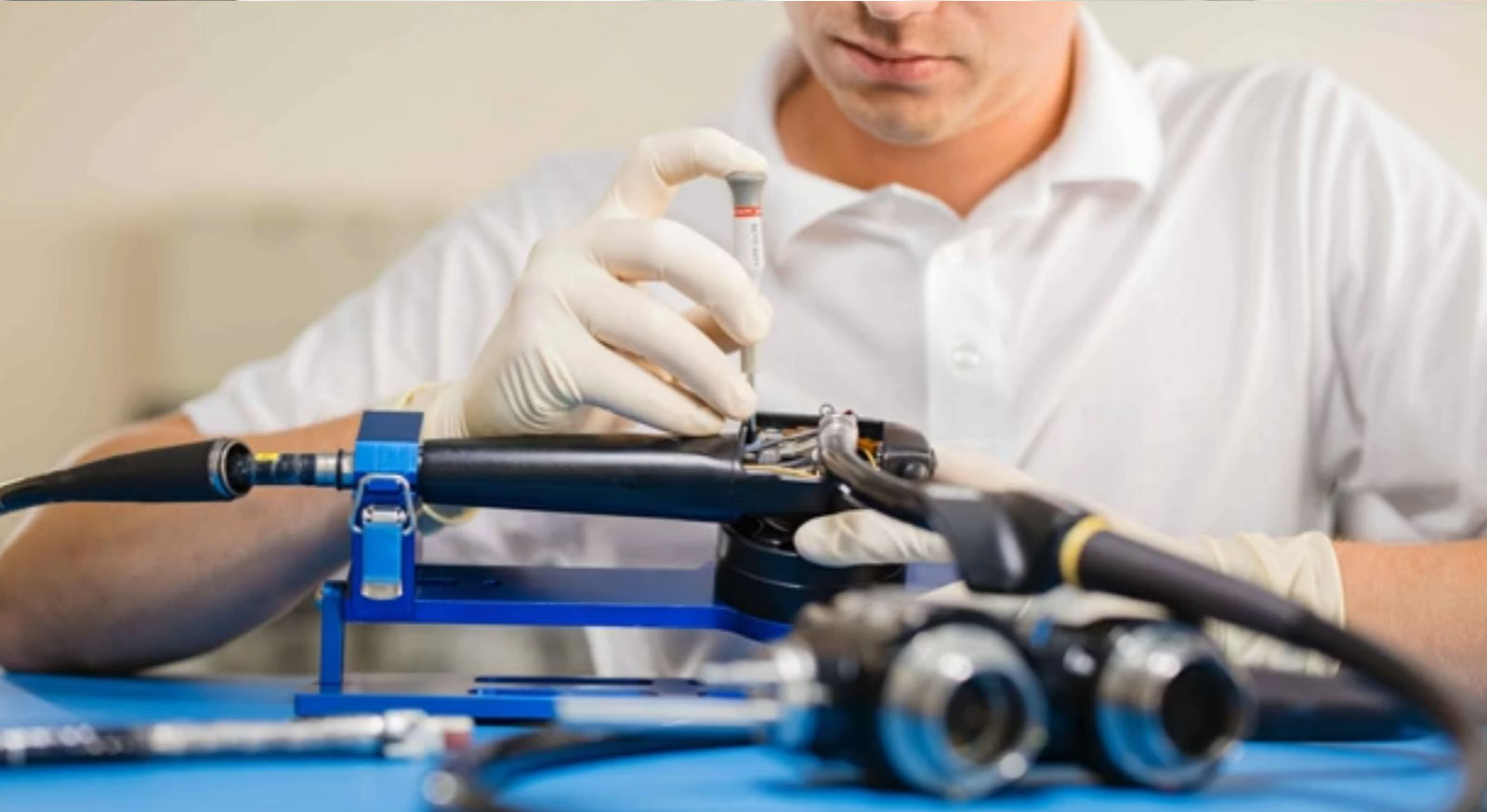
The real wear mechanisms of an ultrasound probe
To build a useful maintenance plan, you need to understand how a probe ages. Not in general theory, but concretely, component by component.
The piezoelectric crystal array is the probe's active core. Dead elements appear progressively, often following impacts or repeated thermal cycles. Ten dead elements out of a hundred aren't necessarily visible to the eye on a routine clinical image — but they degrade sensitivity and axial resolution. A phantom check detects them before they compromise a diagnosis.
The acoustic lens is in direct contact with patients and gels. It undergoes constant chemical attack: disinfectants, particularly alcohol-based or quaternary ammonium products, attack the polyurethane. A cracked or porous lens becomes a vector for cross-contamination, on top of degrading acoustic propagation.
The cable is the most mechanically stressed component. It's wound, unwound, sometimes pinched under an examination table wheel, pulled inadvertently. Conductor breaks rarely happen all at once — they accumulate. A cable with 20% of its conductors cut produces image artefacts hard to distinguish from pathology on ageing equipment.
The connector is subject to repeated insertion stress on the ultrasound machine. Pins oxidise, especially in humid environments (recovery rooms, obstetric theatres). Poor contact shows up as intermittent error messages, often wrongly attributed to the ultrasound machine itself.
Building a preventive maintenance plan: schedules that make sense
There is no universal frequency. It depends on intensity of use, probe type and clinical context. But here are the benchmarks organised biomedical departments apply.
Every use (user protocol)
This is the baseline, and it's down to the operators. Clean off the gel before it dries, visually inspect the lens and cable before placing the probe on the patient, check for no visible cracks. These daily gestures don't replace technical maintenance, but they allow an obvious defect to be flagged quickly.
Quarterly
In-depth inspection by the biomedical technician: lens surface condition (compared against archived photos), controlled flexing of the cable along its full length to detect stiff points, cleaning and inspection of connectors, checking the housing's grip and ergonomics. This is also a good time to review the user fault log.
Annually (or after any repair)
Ultrasound phantom test measuring axial and lateral resolution, assessment of the active element rate, electrical safety test (insulation resistance, leakage currents per IEC 62353). This annual check is essential for endocavity and TEE probes, whose integrity requirements are stricter.
TEE and endocavity probes: maintenance that tolerates no shortcuts
Transoesophageal (TEE) probes deserve a special mention. They operate in an invasive context — inserted into the oesophagus or rectum — and a water-tightness failure is not just an image quality issue, it's a direct infection risk for the patient.
The leak test is mandatory before every use and after every disinfection. A calibrated leak-test manometer detects micro-perforations invisible to the naked eye on the protective sheath. This procedure, often rushed for lack of time, is the first line of defence against a nosocomial infection.
High-level disinfection (HLD) by immersion in glutaraldehyde or endoscope machine processing is non-negotiable for these probes. But repeated HLD cycles degrade materials. A TEE probe used five times a week will experience accelerated sheath wear, justifying more frequent integrity checks than an abdominal probe.
Third-party maintenance: outsourcing probe maintenance without losing control
More and more biomedical departments are entrusting their probe maintenance to a specialist provider, independent of the ultrasound machine's manufacturer. This model — often called third-party or multi-brand maintenance — has concrete advantages.
The third-party provider works across all brands: GE, Philips, Siemens, Mindray, Toshiba. It has no incentive to push replacement when repair will do. And above all, it brings probe expertise that often exceeds that of the ultrasound machine's manufacturer, whose core business isn't transducer repair.
What a good probe maintenance contract should cover:
- initial fleet audit with a documented baseline for each probe
- planned preventive maintenance with intervention reports and traceability
- corrective maintenance with a response time and a loaner probe available
- performance tests after every intervention (results shared with the biomedical department)
- access to an application engineer for technical questions
What the contract should not promise: impossible turnaround times or result guarantees without having seen the fleet's actual condition. A serious provider starts with an audit.
Signs that a probe needs attention now
Even with a preventive plan in place, certain signals should trigger immediate attention, without waiting for the next scheduled visit.
Shadow zones or vertical streaks on the image suggest dead piezoelectric elements. The more numerous and wider they are, the more degraded the probe.
An image that cuts out or fluctuates depending on cable position indicates a partial conductor break. This defect is intermittent and therefore particularly misleading — users tend to suspect machine compatibility rather than a damaged cable.
A "probe not recognised" error message on the ultrasound machine, when the probe has always worked on that device, points to a connector or head electronics problem.
An acoustic lens that has come loose or shows bubbles under its surface should be withdrawn from clinical use immediately. Acoustic transmission is compromised, and the risk of cross-contamination is real if particles come into contact with the patient.
MIDES and Luquet & Duranton: from failure to certified return to service
When a probe reaches the corrective maintenance stage, handling by a specialist lab is the only option that guarantees a return to manufacturer specifications. This is exactly what MIDES does, Europe's leading ultrasonic probe repair company, from its lab in Graz.
Luquet & Duranton is the MIDES partner for France. In practice, this means a French biomedical department entrusting a faulty probe deals with a French-speaking contact, with optimised logistics and a controlled turnaround time. A loaner probe can be made available for the duration of the repair to avoid any interruption to activity.
Repairs covered span the entire diagnostic imaging fleet: linear, convex, endocavity, multiplane TEE, and 3D/4D matrix array probes. After repair, each probe is tested on a phantom and receives a documented compliance report — the same traceability a rigorous biomedical department demands.
Frequently asked questions about probe imaging maintenance
Ultrasound probes are class IIa or IIb medical devices depending on their use. French regulation, aligned with the European MDR 2017/745, requires healthcare facilities to guarantee that their equipment remains fit for its intended purpose throughout its lifetime. In practice, this means documenting maintenance operations and being able to justify the working condition of each device. Undocumented maintenance is a medico-legal risk in the event of an incident.
A well-maintained probe can remain clinically effective for 7 to 10 years, sometimes longer for lightly used models. Without maintenance, serious problems often appear after 4 to 5 years of intensive use. Preventive maintenance doesn't extend lifespan indefinitely, but it prevents premature failure and allows replacement to be planned rather than forced by an emergency.
Yes, and this is what several teaching hospitals do by separating ultrasound machine maintenance (handled by the manufacturer or a multi-brand third party) from probe maintenance (handled by a specialist like MIDES). The two scopes are technically very different — repairing a probe has nothing to do with maintaining an ultrasound machine's acquisition board. Specialisation pays off: providers dedicated to probes achieve repair rates and turnaround times that manufacturers generally don't match.
Irreparable probes must be disposed of through the WEEE (Waste Electrical and Electronic Equipment) channel via an approved collector. They contain heavy metals and electronic components that must not go into ordinary waste. Some repair providers also recover end-of-life probes to recycle their components.